Central Park: A First-Timer's Visit Guide
- New York
- Local Life
- Last verified
Quick answer
Central Park covers 843 acres in the middle of Manhattan, from 59th Street to 110th Street, and it is free to enter every day of the year. This guide plans a first visit the way the park actually works: pick an entrance by subway line, choose the south, middle, or north end for what you want to see, and mix free sights with the few things that charge, like rowboats and the zoo. Everything here comes from the Central Park Conservancy, NYC Parks, the Central Park Zoo, and the Boathouse — with the gaps stated plainly.
Central Park in short
Central Park covers 843 acres in the middle of Manhattan, from 59th Street to 110th Street, between Fifth Avenue on the east and Central Park West on the west. It is free to enter and open daily from 6:00 am to 1:00 am, and the Conservancy calls it America's top tourist attraction, with over 42 million people visiting every year.
The park is cared for by the Central Park Conservancy, a private nonprofit that has looked after it since 1980 and raises nearly 80% of its budget from donors. Entry is free, and what costs money inside is the exception: the zoo, rowboats, skating, and some tours charge, while the lawns, paths, and 21 playgrounds do not.
How to get there: pick your entrance first
There is no single front door and no parking inside the park, so the subway line you take decides where you start. The 4, 5, and 6 trains run along the east side, the 1, 2, 3, B, and C trains along the west side, the B, C, 2, and 3 trains on the north side, and the A, B, C, D, 1, N, R, and Q trains on the south side. The M1, M2, M3, and M4 buses run up the east side, and the M10 and M72 buses serve the west side.
From Grand Central Station it is a 19-minute walk, and from Penn Station it is a 29-minute walk; the M1, M2, and M3 buses also run up Madison Avenue, a block from the park. Only the 4 transverse roads — at 66th, 79th, 86th, and 96th Streets — carry cars through the park. If you lose your bearings, read a lamppost: designed in 1907, the first two numbers on its base give the nearest street, and the last two tell you the side — odd for west, even for east, so 8005 means 80th Street on the west side.
South, middle, north: what each part is best for
- South, 59th to 72nd Street: the classic first visit — the Pond, the Mall and Literary Walk, Sheep Meadow, the zoo, and the carousel.
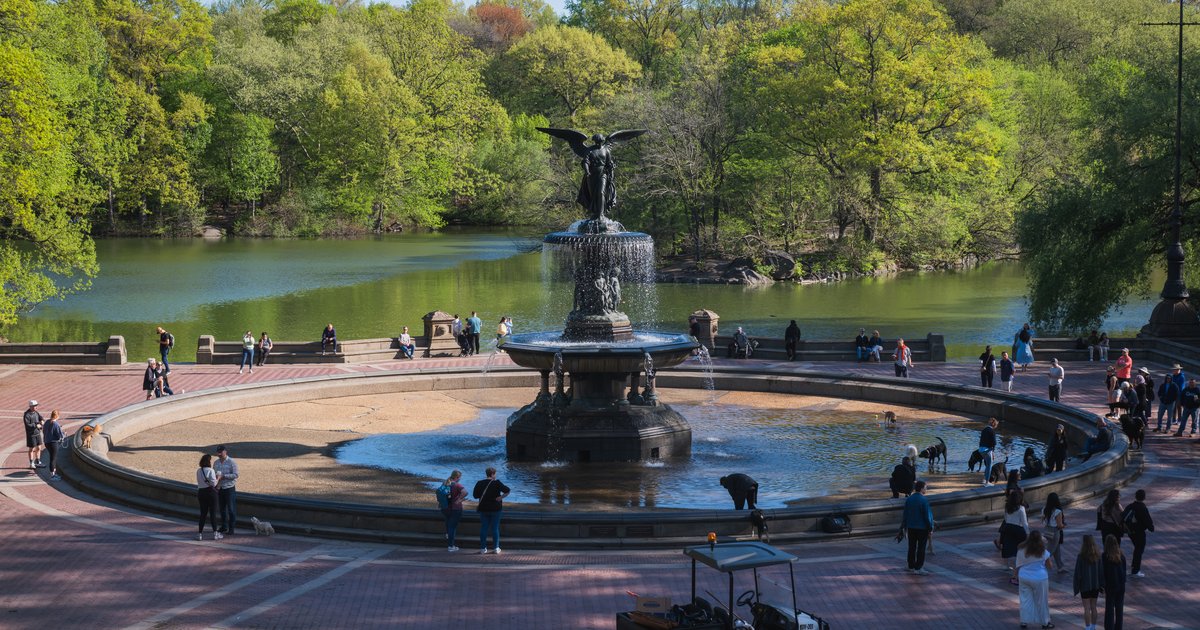
- Middle, 72nd to 86th Street: the heart of the park — Bethesda Terrace and the Lake, the Ramble, Strawberry Fields, Belvedere Castle, the Great Lawn, and Bow Bridge.
- North, 86th to 110th Street: the quiet end — the Conservatory Garden, the Reservoir, the Harlem Meer and the Davis Center, and the North Woods.
The places first-timers remember
Start at the Mall, the elm-lined walk the Conservancy calls an open-air hall of reception, with Literary Walk and its statues of famous writers at the southern end. From there it is a short walk to Bethesda Terrace, at the very center of the park, with Bethesda Fountain and the heavily ornamented Arcade — a backdrop in films from Elf to The Avengers — and to Strawberry Fields, where the Imagine mosaic marks the garden of peace for John Lennon, who lived just across the street.
Belvedere Castle sits on Vista Rock, the second-highest natural point in the park, with views over Turtle Pond, the Great Lawn, and the Ramble. The Alice in Wonderland sculpture was commissioned by George Delacorte as a gift to the children of the city and unveiled by his 11 grandchildren in 1959; children still climb it today. At the north end, the Conservatory Garden holds three gardens in three styles — French in the north, Italianate in the center, and English in the south — and the Obelisk, the oldest outdoor monument in the City, was built around 1425 BCE in Heliopolis, Egypt.
Seneca Village, on the west side between 82nd and 89th Streets, was a thriving Black community with three churches and a school before the City used eminent domain to build the park and its residents were made to leave by 1857. The Conservancy now researches and interprets the site, and its tours stop there.
Sources3
Free and paid: what costs money
Most of the park is free: the lawns, the paths, the 21 playgrounds, and birdwatching — more than 210 bird species pass through the park each year, on the Atlantic Flyway. The Conservancy's official tours are the only organized tours that directly support the care of the park, and its guides wear official uniforms with the Conservancy logo.
Rowboats on the Lake are the classic paid outing. The Boathouse rents them first come, first served, with no reservations, at $25 an hour Monday through Thursday and $30 Friday through Sunday. Boats go out daily from 10:00 am in season, from spring through fall, with the last rentals at 5:30 pm and boats back by 6:30 pm. Each rowboat holds up to 4 people, and kayaks are also available.
The Central Park Zoo, at Fifth Avenue and 64th Street, is the park's one ticketed attraction in the south end. Adults ages 13 and older pay $22.95, seniors ages 65 and older pay $18.95, and children ages 3 to 12 pay $16.95, with children 2 and under free. In the winter months the zoo is open daily from 10:00 am to 4:30 pm, with last entry 1 hour before closing; summer hours run later. Every visitor needs a date-specific ticket, and all sales are final.
In winter, the Davis Center at the Harlem Meer, at the north end, runs the Gottesman Rink, with skating lessons for all ages and skill levels. Skating season returns each winter — check the Davis Center site for the season's dates and prices.
How much time to plan
A first visit needs at least half a day: the south end plus Bethesda Terrace is the classic loop, and the middle of the park fills a full afternoon. A whole day covers the north end too — the Conservatory Garden, the Harlem Meer, and the North Woods — but the Conservancy publishes no suggested duration for the park as a whole, so treat these as a starting point, not a route to finish.
Start at one of the 5 visitor centers — the Columbus Circle Information Kiosk, the Dairy, the Chess & Checkers House, Belvedere Castle, or the Charles A. Dana Discovery Center — for a free map and directions from staff. The Conservancy also publishes seasonal guides, including a Fall Guide, a Birdwatching Guide, and a Running Guide.
Before you go
Check the Conservancy's alerts page before you go: the Bethesda Fountain is under restoration, and storms, events, and maintenance can close paths or facilities. Restrooms are free throughout the park except at the zoo, where access requires a purchase. There is no parking inside the park, and only the 4 transverse roads carry cars.
For emergencies call 911; for general questions call NYC 311, and for wildlife or injured animals call the Urban Park Rangers at 212-360-2774. Lost items go to the NYPD Central Park Precinct by the 86th Street Transverse Road.
What the sources reviewed do not cover: the Conservancy's detailed rules for bikes, pets, grilling, and wildlife live in its Help Center and were not extractable here — check them before bringing a bike or a dog. The Boathouse publishes no fixed closing date for rowboat season, and per-place hours shift with the seasons, so confirm times on the day.
Local context
The park is free and open from 6:00 am to 1:00 am every day, but the things inside it are not all free — rowboats and the zoo charge, and the Conservancy's own tours are the only organized tours that directly support the park's care.
Central Park is 843 acres with no single front door, so the entrance you pick decides your day: the south end is the classic first visit, the middle holds the Terrace, the Lake, and the Ramble, and the north end is the quietest.
The Conservancy, the nonprofit that has cared for the park since 1980, raises nearly 80% of the park's budget from donors — the free map at any of the 5 visitor centers is a good first stop.